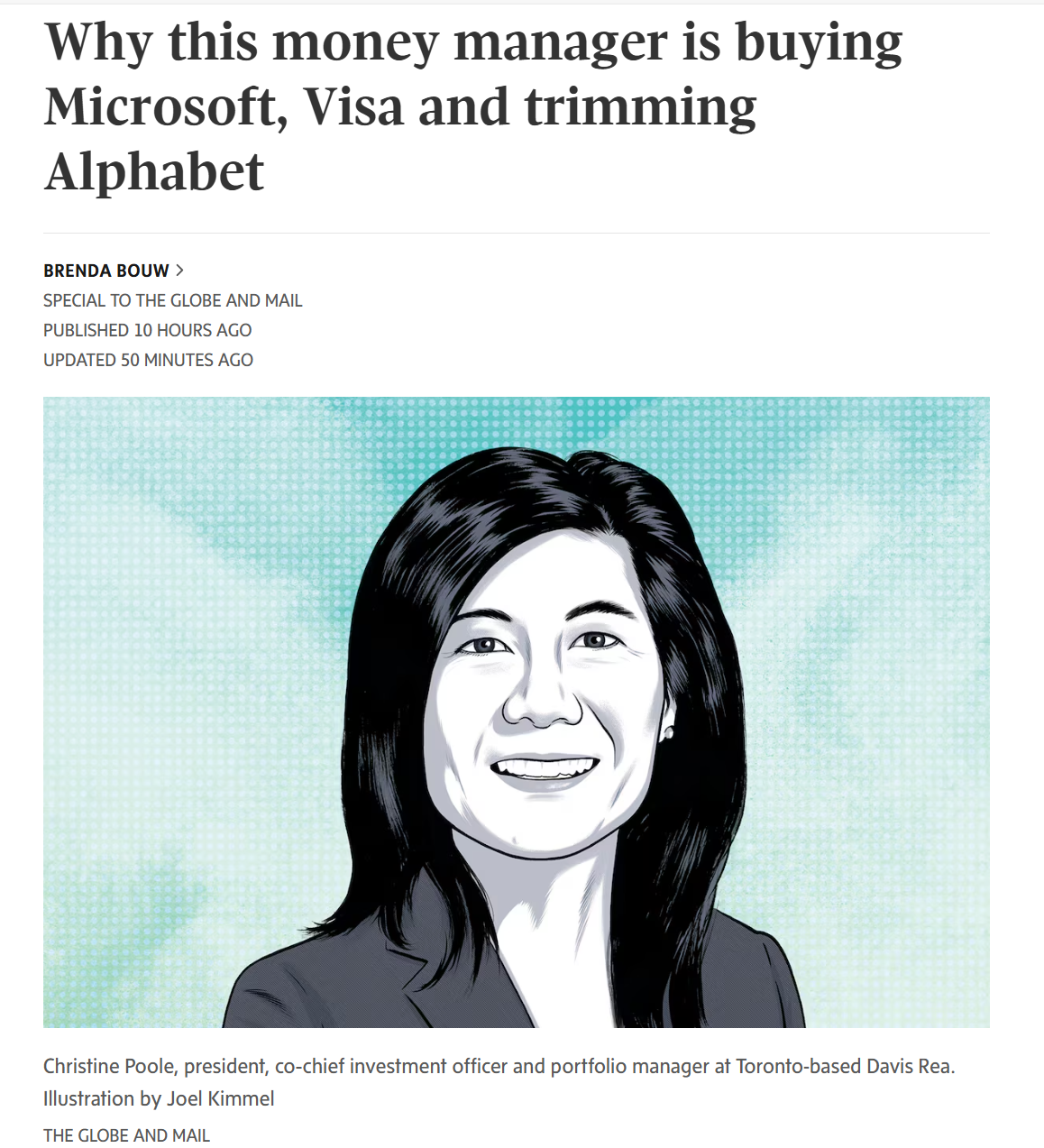
While stock markets continue to grind higher, making rich valuations even richer, money manager Christine Poole says there are still many companies priced attractively for long-term investors to buy.
“We’ve had two consecutive years of very strong performance, but arguably it’s been quite narrow in Canada and the U.S.,” says Ms. Poole, president, co‑chief investment officer and portfolio manager at Toronto-based Davis Rea Ltd., who oversees about $316-million of the firm’s $870-million in assets.
Ms. Poole says most of the growth in Canada has been in precious metals, materials and financial stocks, while U.S. market growth has been driven by technology, specifically companies focused on artificial intelligence.
Despite ongoing geopolitical risks, Ms. Poole believes the lower interest-rate environment and government stimulus will help grow the economy and, in turn, corporate earnings. She points to increases in defence and infrastructure spending in Canada, as well as tax cuts and other stimulus programs in the U.S.
“There are some things that will be supportive for the consumer, which obviously will be positive for economic growth,” she says.
Her all-equity client portfolios, which include about 40 per cent Canadian and 60 per cent U.S. stocks, returned 14.5 per cent in 2025. The three- and five-year annualized returns were 14.6 per cent and 11.4 per cent, respectively. The performance is based on total returns, net of fees.
The Globe spoke with Ms. Poole about what she’s been buying and selling:
Name three stocks you own today and why.
Visa Inc., the global payments company, is a stock we bought originally in June, 2014, for US$52 a share [price adjusted for a four-for-one stock split in March, 2015] and have continued to buy over the years. We bought more of it recently at US$326 when the stock pulled back after U.S. President Donald Trump announced his support for the Credit Card Competition Act in the U.S., which would introduce more competition into the payment processing market. But the banks aren’t supportive because they would have to invest a lot to rejig their payment systems. We saw it as an attractive entry point.
We like the long-term thesis on Visa as the world continues to transition away from cash and cheques toward electronic payments. Visa is also the largest network, has significant scale and generates substantial free cash flow. It has also been developing its non-transactional business, such as cybersecurity services, which are less sensitive to transaction volume.
Microsoft Corp., the technology giant, is a stock we first bought in October, 2018, for US$103 a share. We’ve continued to buy it, including recently for US$454.
We think the company is well-positioned to participate in the growth of AI. It’s monetizing AI through its Copilot platform. It has a very large installed base, customers are paying a subscription to use it, and it’s growing. It’s also embedding AI into its overall operations.
Microsoft is also doing well with its Azure cloud computing business, which is No. 2 behind Amazon Web Services. The company is highly profitable and generates substantial cash flow. It also owns the widely used LinkedIn social media platform and a leading gaming platform.
Fortis Inc., the regulated electric and gas utility company, is a stock we’ve owned since May 2009, for an initial price of $23 a share. We continued to buy it over the years, including recently for $72 a share.
Fortis generates about 60 per cent of its cash flow from the United States, where it’s seeing growth. We expect continued growth amid demand for data centres, which consume a lot of power. Fortis has also increased its dividend for 52 consecutive years, and we expect that trend to continue. It has an attractive dividend yield of 3.5 per cent.
It’s not the highest-growth stock, but it’s a good defensive name with a steady income stream to own in a diversified portfolio.
Name a stock you’ve sold or trimmed recently.
Alphabet Inc., the parent of Google and YouTube, is a stock we’ve been trimming in the past month or so. The stock was out of favour at the beginning of last year. There was the antitrust case against Google and concerns it would have to divest Chrome [its web browser], but a September ruling saw it avoid the worst-case penalties.
There were also concerns AI would impact business, but its recent financial results have been quite strong. It has also been releasing a new version of its AI platform, Gemini, which is widely viewed as among the best in the market. The stock is up about 60 per cent since the middle of last year and it went beyond our target weight, so we felt it was prudent to take some profits. It’s still a core holding at about 4.5 per cent.
This interview has been edited and condensed.


